
(Image of the Advent wreath is from ImageVine/courtesy of www.imagevine.com. All rights reserved.)
(Is 25:6-10; Mt 15:29-37)
Our readings present us with a look at what is to come in our lives. They tell of the Messianic banquet and that period of time when there will be peace and tranquility. The future holds grace and hope for us.
Isaiah mentions this hope and Matthew’s gospel has Jesus curing those who are ill. He gives bread to those in need in order that they will not grow faint. We are those in need. God gives to us in great measure.
The season of Advent is a time of reflection and expectant prayer. We see the direction of our lives and prayerfully seek change and improvement. Jesus will feed us and direct us as we proceed on our Journey.
This journey is filled with God’s graces and blessings. God’s Word is our way. We cannot help but be moved to greater spiritual longings and directions. Our lives will be full because they look forward to each day being a time of grace and fulfillment. We long for what is to happen in the present and in the time to come.
Let us pray in this season of preparation and expectation to be instruments of God’s will. May each of us follow in the path of the expected Savior.
– Fr. Vianney Cunningham, T.O.R.
Tuesday, November 29, 2011
According to Your Word - Wednesday of the First Week of Advent
Monday, November 28, 2011
According to Your Word - Tuesday of the First Week of Advent

(Image of the Advent wreath is from ImageVine/courtesy of www.imagevine.com. All rights reserved.)
(Is 11:1-10; Lk 10: 21-24)
A philosopher once said: “Walk straight into the peace of God; don’t look back; don’t ask if you are there yet; just keep walking.” We live in a world that seems to question everything. I believe we question so often, that we don’t take time to enjoy the possibilities for our lives. One possibility is that God’s peace is with us in this season of Advent, and can grow within us, if only we are open to that peace.
Isaiah reminds us that “the spirit of the Lord is upon us,” and the promise of that spirit is a kingdom of peace. This is a message of hope, in these days of war and ongoing terrorist threats. Luke reminds us that in the same way Jesus’ disciples are blessed, we too are blessed with the peace and hope that comes from knowing that God loves us so much, that He sent His only Son to be with us: to teach us, heal us, love us, and be a part of our daily lives, if only we ask for His presence.
But, if we continue to question the possibility of peace, hope, and what Jesus can do for us, then we speak only with our minds and not our hearts. It is the response of the heart that says: “I need the peace and hope that only the Savior of the world can give me. I don’t have to understand it; I just need it.” We can discover that peace and hope in this season of Advent. Before our minds question the possibilities, may our hearts embrace these gifts, each and every day, so that this will be our best Christmas ever. God bless you!
– Fr. Brad Baldwin, TO.R.
Sunday, November 27, 2011
According to Your Word - Monday of the First Week of Advent
 (Image of the Advent wreath is from ImageVine/courtesy of www.imagevine.com. All rights reserved.)
 ADVENT
(poem by Jean Burden)
Before you come
old springs flower
in the silence of my earth
and rivers locked for seasons
in my cold
flow with longing
toward the hour.
And this is love, I know:
to wait
composed as stone
while ancient nativities
tremble in my darkness
gathering a violence
of their own.
– poem offered for reflection by Bro. Didacus Wilson, T.O.R.
Wednesday, November 23, 2011
According to Your Word - First Sunday of Advent
 (Image of the Advent wreath is from ImageVine/courtesy of www.imagevine.com. All rights reserved.)
Cycle B
(Is 63:16,17,19,64: 2-7; I Cor 1:3-9; Mk 13:33-37)
Watchfulness is the word that fills the Scripture reading and begins this new Liturgical Year. For the community of Israel listening to the prophetic words of Isaiah, it is a watchfulness for the actions of God who is the “faithful Father.” For the community gathered to hear the Good News according to Mark, it is a watchfulness for the actions of Jesus Christ, God’s faithful Son.
While the community of Israel was enjoying a respite from enemy attack and exile, their relative ease found them forgetful of the God who is their very life. Verse 5 of chapter 64 remarks: Would that you might meet us doing right, that we were mindful of you in our ways! They were losing sight of their true identity, which was always to be a reflection of God’s just and loving ways. Yet because God is always the “faithful Father,” faithful men and women, like the prophets, were sent to remind them. Advent is the time when Christians are reminded to keep a faithful watch for the coming of the Lord Jesus Christ.
And the liturgy, whose spirituality is really about remaining watchful for the Lord in all the aspects of our lives, helps us to remember that God is our very life. How can we do this? St. Paul’s exhortation to the Corinthians pays tribute to the many gifts that infuse the church and tells them that these gifts flow from God. Such gifts, whatever they are, should be used to build up fellowship with one another and, therefore, with the Lord Jesus Christ. Thus, the Advent summons will bring us to incarnate the ultimate gift that Paul will later address in Chapter 13: Love. Incarnate Love: the feast that we prepare to remember as the first Christmas and the feast that we will live eternally as the last.
– Fr. Carl Vacek, T.O.R.
According to Your Word - Reflections for the Advent & Christmas Seasons
The Coat of Arms for the Province of the Immaculate Conception bears the inscription, “According to Your Word.” The text is from the Gospel of Luke and comes from the story of the angel Gabriel’s announcement to Mary that she is to bear a child. Mary, moving beyond her incredulity and her fear, acknowledges her dependence upon God, assents to the request, and utters words that changed the course of history, “Let it be done to me according to your word.”
This radical assent to God marks the lives of the friars of our Franciscan Province of the Immaculate Conception. Following Mary’s lead, we have vowed ourselves to live in a stance of a daily turning in faith to God, fostering hope in God’s promises, and living love enfleshed in generous service.
The seasons of Advent and Christmas are especially dear to Franciscans. The following reflections were originally released in According to Your Word, a three booklet series featuring some of our friars’ reflections on the cycle of scripture readings for the Advent and Christmas season. We offer these brief reflections to you in a spirit of faith, hope and love: faith in God’s power continuing to manifest itself in today's world through weakness; hope, that as you pray through the readings and reflections a prayerful bond will be formed between you and our friars; love, knowing that only through acts of love will our lives be formed according to God’s Word.
The following reflections are offered as one way to sustain a prayerful focus through what is very often the hectic seasons of Advent and Christmas. The friars of the Province were invited to prepare a brief reflection on the daily scripture readings of the Church’s liturgy. The fruit of these meditations is reprinted in the following blog posts.
Part of the beauty of the Province of the Immaculate Conception is the diversity of the men who have committed themselves to following the Franciscan way of life. That diversity is reflected in these writings. No attempt has been made to reconcile the various writing styles or theological viewpoints. What you will find in common in these reflections and among our friars is a very human approach to the great mystery of the incarnation. Franciscans are noted for their popular and accessible preaching. This fact is evidenced in these prayerful reflections provided for your daily meditation.
We invite you to prayerfully enter this season of incarnation. Take a few moments each day to read the assigned scripture readings. Ask the Holy Spirit for insight and wisdom to guide your personal reflection. Afterward, read what the friars offer for reflection on the scripture passage assigned each day. Because this is a season when we ponder the implications of what it means that the Word became flesh, on some days the written reflection is replaced with an activity. You are invited to participate in that activity or to choose some other way to allow your prayer to find expression in action. Finally, we ask that you take a moment to say a prayer for the friar whose reflection you have read. As Franciscan Friars, we are men who have dedicated our lives to helping others discover and grow in love for the Word made flesh. Pray for us that we may remain faithful to our vows, farsighted in our vision, and courageous in our response. For our deceased Friars, pray that they may enjoy God’s eternal embrace of peace of love.
May these seasons of Advent and Christmas be a time of great grace so that your heart and ours may respond daily to the mystery of God-among-us with the life-changing assent, “Let it be done unto me according to your word.”
Be assured of our heartfelt prayers. With a share in the love that God has for you.
– The Franciscan Friars,
Province of the Immaculate Conception, USA
Sunday, August 7, 2011
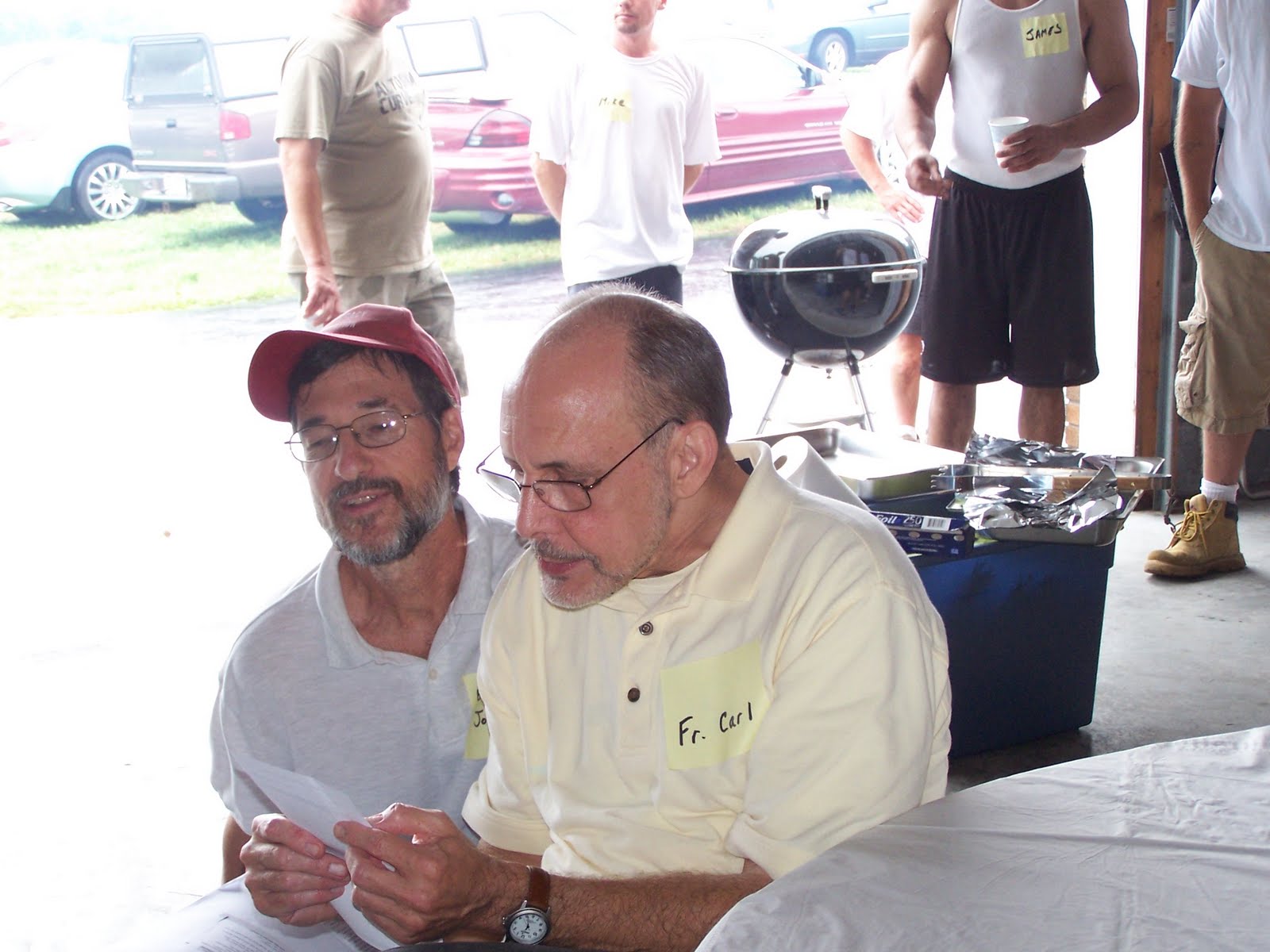
Summer Bounty Festival Brings Central Pennsylvania Community Together
 |  |
 |  |
 |  |
 |  |
Monday, July 25, 2011
Br. Corey Smoot, TOR Professes Vows


Saturday, June 11, 2011
Blessing of the Community Garden


 On a beautiful spring day at the end of May, Fr. Eugene Kubina, TOR blessed the 2011 community garden at St. Bernardine's Monastery. Br. John Kerr, TOR (middle) welcomed friars and gardeners. All celebrated a potluck lunch afterward at the Care for Creation Center.
Sunday, May 1, 2011
Second Sunday of Easter: Belief without Seeing as Transformation in the Spirit
The Gospel of John is wholly unique in the way that it depicts Christ's Resurrection and his first appearance to the disciples (John 20:19-31). Unlike the other Gospel writers who have Jesus rising, spending a period of time with his disciples instructing them, ascending to heaven, and than sending the Holy Spirit to them (Pentecost), John conflates the Resurrection and sending of the Spirit into one event occurring simultaneously. To conflate two things or ideas is to "bring them together; to meld or fuse them." What is the significance of conflating the Resurrection and the sending of the Spirit in John? To begin with, it's important to bear in mind that John was written 30-40 years after the other Gospels. Hence, the Christian community had the opportunity to mull over, reflect on, and experience the power of Christ's Resurrection for some time. Therefore, we can presume that the point isn't a historical one but a theological one. The Christian community has come to understand the Resurrection not merely as God's "antidote" to death, nor even sin, but, as the "doorway" to new life in Christ through the Holy Spirit. "Belief" in Jesus no longer is a matter of seeing the risen Lord, nor even professing faith in Christ's with one's lips, but, even more, by being transformed through the Spirit. Jesus tells Thomas after appearing to him, "blessed are those who have not seen and believed." (John 20:29). We are indeed blessed in not seeing the Lord because we must rely, rather, on the presence of the Spirit in our lives as a guiding and empowering force which transforms us, our relationships, our communities, and, even our world ever slowly but surely into a "Christ-like" environs that is more open to God's Kingdom.
To see an example of what it means to believe in Christ as transformation through the Spirit, take for example the aftermath of the horrific storms that ripped through Alabama, Mississippi, and a number of other southern states this past week. Despite the apocalyptic-like carnage surrounding the survivors of these storms, many have spoken of how fortunate and blessed they feel to be alive, of having a new appreciation for life, of relationships that are being strengthened through this tragedy, and of communities that are drawing together more closely in mutual support, care, concern, and love. The bonds being formed among members of these devastated communities and those who are reaching out to them both near and far speak to similar dynamics that were at the heart of the early Christian communities mentioned in today's first reading from the Acts of the Apostles: "They devoted themselves
to the teaching of the apostles and to the communal life,
to the breaking of bread and to the prayers.
Awe came upon everyone,
and many wonders and signs were done through the apostles.
All who believed were together and had all things in common." (Acts 2:42-47). The Risen Lord is indeed at work every bit as much today as he was immediately after the Resurrection, forming disciples whose faith is grounded not in seeing but in transformation through the Spirit. Pat, TOR
Friday, April 29, 2011
Taste of New Creation: Dispositional, Relational, and Communal
The stories of Christ's Post-Resurrection interactions with the disciples and the Book of the Acts of the Apostles gives plenty of insight into how the power of Christ's Resurrection and the promise of new life avails itself to us. To begin with, we see the effect that Christ's Resurrection has on the disciples disposition. Through their interactions with Jesus after his Resurrection (c.f., the Road to Emmaus story in Luke 24:13-35) the disciples come to an entirely new way of understanding the mystery of Jesus (as a suffering Messiah) and how that mystery applies to their own lives (as those who will likewise struggle and suffer for Christ). Another effect of Christ's Resurrection and taste of the New Creation is relational in nature. In John's account of the Resurrection (John 20:19-31), John has Jesus not only appearing to the disciples, but breathing into them the Holy Spirit. Unlike the other Gospel writers, John ties the Resurrection of Christ to the intimate presence of the Spirit being given to those who are related to Jesus. New creation now consists in a completely unparalleled bond to Jesus in and through the Spirit who is both the Spirit of God and the Spirit of his Son. Finally, a taste of new creation is experienced through the new communal ties made possible by Jesus' Resurrection. Through Jesus' Spirit dwelling in the hearts of the first Christians in the Book of the Acts of the Apostles, a community of worship and mutual support is formed in which no one is in need of anything (Acts 2:42-47).
Just as the earliest disciples "tasted" and experienced new creation, so can we. Through allowing the Lord's Words in scripture to take hold of our imaginations and settle deeply into our hearts, our dispositions change from being "reactive" to life's events to being "reflective" and deliberately interpreting all of life's circumstances through a "paschal" (meaning, Christ-like) frame of reference (for more on this, see Tuesday's blog reflection). We likewise experience new creation when we open ourselves to the presence of the Holy Spirit at work in our lives and our world. This can be as easy as talking a walk in nature and being drawn into the beauty and fragility of the web of life or it can be as challenging as making more deliberate decisions regarding what information we allow into our lives (following the proverb, "garbage in, garbage out"). Lastly, new creation cannot be experienced in all of it's robustness without an integral connection and commitment to community. This implies being led by the Spirit of the Resurrected Lord to some degree of involvement at all levels of community: socio, cultural, and political. It means taking a stand for the values of the Kingdom and working hard to sew them into the fabric of culture - not with the aim of making culture Christian but, rather, making it open to the Reign of God that is already among us but not fully so. The experience of new creation made possible by Christ's Resurrection is something that is indeed accessible to us, all we need do is allow ourselves to be more deeply and powerfully drawn into this ever-present though very subtle mystery. Pat, TOR
Wednesday, April 27, 2011
Road to Emmaus: Pathway to Paschal Mystery
The Gospel from today's Daily Mass tells the story of two disciples of Jesus on the road to Emmaus after the Crucifixion and alleged Resurrection of the Lord (Luke 24:13-35). They are discussing the events that have recently unfolded when Jesus joins them in such a way that they are unable to recognize him. He joins in the discussion and asks what they are talking about. They seem incredulous that he isn't aware of what has transpired. They tell him about Jesus, their dashed hopes as a result of his crucifixion, and the Resurrection event reported by some women disciples. Jesus than turns the tables in dramatic fashion and remonstrates them with equally forceful credulity at the disciples hardness of heart in not understanding that the Messiah was destined to suffer and sacrifice. Jesus than interprets all the scriptural passages of the Hebrew Scriptures that refer to him in a way that begins correcting their flawed understanding.
The story of the journey to Emmaus is less historical than metaphorical. The "Road to Emmaus" is a portrait of the life of discipleship and how it is a matter of acquiring a new way of seeing and experiencing reality, and, ultimately, walking the pathway to Paschal Mystery. Initially the disciples are "reactive" to the circumstances of Jesus' crucifixion and Resurrection - meaning, they are reacting with the normal, knee-jerk and very human response of the "woe is me" emotions of confusion, fear, disorientation, and, even, sorrow, and perhaps a tinge of self-pity. What Jesus exhorts them to do is to exchange their "reactive" response for a reflective response. A reflective response is one that is grounded not only in objectively analyzing a situation but also making a free choice of how to interpret an event, and, for that matter, our lives. In so many words, Jesus is helping the disciples to not only understand the facts of scripture more accurately in regards to himself, but, more importantly, he is empowering them to choose hope and new life rather than surrender to despair and death.
I recently experienced a bit of a health set-back at a very inopportune time. Initially, I "reacted" to the news with a "woe-is-me" complex and for a time was yielding to fear, sorrow, and self-pity. I asked the question, "why THIS and why NOW?" Than, after being moved by what I believe was a genuine nudge of the Spirit, I transitioned into a mode of a more reflective understanding. In reflecting on this set-back, I realized that it is much better that I experience it precisely now rather than even two months from now or later. In a sense I chose to opt for hope and new life rather than to yield to despair. The main reason for moving from reactive to reflective understanding isn't so that we can be more positive, it's so that we can be more paschal. A positive attitude is something that more or less rides along the surface at best, and, at worst, can be a bit "polly-annish" because it fails to recognize or react appropriately to truly disturbing and distressing events. Sometimes lemons simply can't be made into lemonade - life doesn't always provide the water and sugar!! A paschal attitude, to the contrary, is about something much deeper: namely, the hope that the cards life deals us, even the ominous and threatening, can be an occasion for being drawn closer to God and to others as sources of love, support, and new life. Pat, TOR
Sunday, April 24, 2011
Prayer before the Crucifix Collage
Prayer before the Crucifix [1]
Iconic image collage(2011) by Bro. Jeffrey Wilson, T.O.R.

Prayer before the Crucifix [2]
by St. Francis of Assisi
Most High,
glorious God,
enlighten the darkness of my heart
and give me
true faith,
certain hope,
and perfect charity,
sense and knowledge,
Lord,
that I may carry out
Your holy and true command.
This work takes the perspective of St. Francis kneeling and praying before a crucifix in an abandoned church that has fallen into ruin.
“Seeking out solitary places, he [Francis] used to go to deserted and abandoned churches to pray at night. [3] […] One day when he went out to meditate in the fields, he walked near the church of San Damiano, which was threatening to collapse because of age. Impelled by the Spirit, he went inside to pray. Prostrate before an image of the Crucified, he was filled with no little consolation as he prayed. When tear-filled eyes were gazing at the Lord’s cross he heard in a marvelous way with his bodily ears a voice coming from that cross, telling him three times: “Francis, go, rebuild my house which, as you see, is all being destroyed!” [4] […] The voice from the Cross, which repeated three times the command concerning the rebuilding of the house of God, stands out as a prophetic sign. We recognize now that it is fulfilled in the three Orders established by him.” [5]
Visually, this work is inspired by several works of Salvador Dali, particularly Christ of St John of the Cross, Corpus Hypercubus, and The Ascension of Christ. I was interested in the play between vertical and horizontal perspectives in Christ of St John of the Cross; the detachment of the body, or corpus, of Christ from the cross in Corpus Hypercubus; and the suspension of the body of Christ in The Ascension of Christ.
The image of the crucified Christ can be viewed from both a vertical and horizontal perspective. In relation to the wall and statues, the crucified Christ is viewed from a vertical perspective. This is the more literal and natural perspective. In relation to the Earth, sun, and nebula; the crucified Christ is viewed from a horizontal perspective. This is the metaphorical and supernatural perspective.
In the traditional analogy for the natural and supernatural, horizontal represents the natural while vertical represents the supernatural. I do not intend to collapse the vertical into the horizontal or the immanent Trinity into the economic Trinity. [6] The inverting of the analogical vertical and horizontal perspectives symbolizes Francis’ insightful vision of the created world. The created order mirrors the Triune God. As the Most High God is perfect Trinity (diversity) and simple Unity (one), so too is God’s creation. [7] The created universe is diverse yet unified and ordered. [8]
The sunlight reflecting off of the surface of the Earth symbolizes creation mirroring God. In addition, the sun’s reflection represents St. Clare’s theme of the mirror of contemplation. She instructs, “Place your mind before the mirror of eternity! Place your soul in the brilliance of glory! Place your heart in the figure of the divine substance and, through contemplation, transform your entire being into the image of the Godhead Itself, so that you may feel what friends feel in tasting the hidden sweetness that, from the beginning, God Himself has reserved for His lovers.” [13]
------------------
[1] The Earth and space images are from NASA/courtesy of nasaimages.org.
[2] Francis of Assisi: Early Documents, Vol. 1 - The Saint. Eds. Regis J. Armstrong, O.F.M. Cap., J.A. Wayne Hellman, O.F.M. Conv., and William J. Short, O.F.M. (New York: New City Press, 1999), 40.
[3] St. Bonaventure, The Major Legend of Saint Francis, ch. 10, 3.
[4] St. Bonaventure, The Minor Legend of Saint Francis, ch. 1.5.
[5] Ibid., ch. 1.9.
[6] Karl Rahner explains, “The “economic” Trinity is the “immanent” Trinity and the “immanent” Trinity is the “economic” Trinity.” Karl Rahner, The Trinity, (New York: Herder & Herder, 1970), 22. Or in other words, as Fr. Thomas Weinandy, O.F.M., Cap. explains, “With regards to revelation […] the manner in which the Trinity reveals himself in the economy is in keeping with the manner it is in itself.” Thomas Weinandy, O.F.M., Cap., Does God Suffer?, (University of Notre Dame Press, 2000), 142.
[7] “Most High, Who live and rule in perfect Trinity and simple Unity, and are glorified God almighty, forever and ever.” St. Francis of Assisi, A Letter to the Entire Order, 52.
[8] Weinandy explains, “We clearly perceive now the awesome truth that because creatures, especially human persons, are in the act of creation related to the persons of the Trinity as they are in their own subsistent relations, and so are related to each person of the Trinity in a specific and proper manner, they are assumed in the very mystery of the Trinity itself. Thus, the act of creation mirrors, though imperfectly, the processions within the Trinity.” Does God Suffer?, 142.
[9] St. Francis of Assisi, The Testament, 5.
[10] A Book of Exemplary Stories, 98.
[11] Thomas of Celano, The Life of Saint Francis, 71.
[12] All scripture quotes are from the New Revised Standard Version (NRSV) translation unless otherwise noted.
[13] St. Clare of Assisi, The Third Letter to Agnes of Prague.
[14] St. Bonaventure, The Soul’s Journey into God, ch. 4, 2.
Thursday, April 21, 2011
"Wholly Thursday": Wholly Receiving and Wholly Giving
Following the theme of the last two blog entries concerning a slight twist on "Holy Week" as "Wholly Week" (the week in which we remember how Christ gave himself "wholly" to us), what might be gained from approaching Holy Thursday as "Wholly Thursday?" Holy Thursday is traditionally celebrated as the Institution of the Lord's Supper and commemorates the last, Passover style meal that Jesus had with his disciples. One focus of the meal is Jesus' "ritualizing" his impending and total self-offering to God and humanity for the life of the world. The other aspect is the call of Jesus for his disciples to follow his example by offering themselves in this self-same way. Jesus "ritualizes" his gift of self through the symbols of bread and wine. The bread he breaks and the wine he pours at the meal symbolize how, throughout his three year ministry, he has shared and poured himself out unhesitatingly for the well-being of others. Now, at the end of his life, and with the ominous clouds of crucifixion on the horizon, Jesus doesn't hide away in a corner but "he love his own in the world and he loves them to the end." (John 13:1). The Last Supper is the "swan song", "pinnacle", and "crescendo" of the deep meaning behind all of Jesus' actions on behalf of others. It is the summation (summary) and con-summation (fulfillment) of all that he has done and all that he is about. What the Last Supper symbolizes, summarizes, and fulfills is Jesus wholly giving himself for the life of others and for the life of the world.
In a sense, therefore, "Wholly Thursday" is about "wholly receiving" the gift of Christ as the One who alone can penetrate the depths of the ambiguity and complexity of our lives and world to bring light, purpose, hope, healing, transformation, and, in a word, redemption. How can we be assured of this? Because, time and time again, Jesus did this for others during his ministry and, when the going got tough (meaning his life was on the line), he didn't turn tail and run but dug in even deeper in his resolve to be gift for others - even when it meant forfeiting his own life. The Last Supper, in a very real sense, was Jesus' "digging in" - not to defend his own life but to "defend" (meaning, "redeem") the life of others for generations to come. However, as much as Holy Thursday is about Jesus' wholly giving himself, it is also about our "wholly receiving" this gift and "wholly giving" it to others.
This comes across clearly in the way in which the Gospel of John depicts the Last Supper (John 13:1-15). These passages of John relate the dramatic actions of Jesus in washing the feet of his disciples and than instructing them to do likewise. This gesture would have been completely "over the top" for Jesus' disciples. Rabbi's and revered masters simply did not bend so low in a mode of condescending service. Peter even objects to this action, apparently appalled by his Master's gesture. Yet Jesus insists that if Peter is to be in communion with him, he must open himself and wholly receive this new, saving way of being and relating to God. What, precisely is this new way of being and relating? It consists of the continual process of opening ourselves wholly to receiving the way in which God desires to serve and save us as Father, Son, and Holy Spirit. This way of serving, saving, or "gracing" us, has little to do with outward favors granted by God (material blessings, etc...) and is about allowing God to "condescend" and bend so low as to reach, touch, wash, and heal the parts of us that are most smelly, messy, insecure, fragile, broken, forsaken, and alienated. Yet, this is just one part of the challenge of Wholly Thursday. The other aspect of entering into a true and saving relationship with God means being willing to "wholly give" the gift that we've received. In other words, we must also be willing to condescend and serve by reaching, touching, washing, and healing those parts of others and our world that are smelly, messy, insecure, fragile, broken, forsaken, and alienated. For, Jesus himself says at the end of this Gospel, “Do you realize what I have done for you?
You call me ‘teacher’ and ‘master,’ and rightly so, for indeed I am.
If I, therefore, the master and teacher, have washed your feet,
you ought to wash one another’s feet.
I have given you a model to follow,
so that as I have done for you, you should also do.” Pat, TOR
Wednesday, April 20, 2011
"Wholly Week": Wholly Impenetrable Mystery of Christ, Life, and Our Very Selves
In Monday's blog reflection I proposed that Christian's shift the focus during Holy Week from viewing Christ's passion and death as primarily an offering for sin and exploring it as a "bridge" to a deepened, healing, and transformative communion with the Trinity of God, Father, Son, and Holy Spirit. In other words, I proposed that Christian's view this week as "Wholly Week": the week in which we remember how Christ gave himself "wholly" for us that we might never be alone in all the experiences that constitute human life: especially experiences of struggle, suffering, tragedy, rejection, abandonment, and, even death. The reason for this shift of focus is quite straightforward: it forms a robust basis for a life-long love relationship with God.
When God gives himself "Wholly" to us in Christ and Holy Spirit, this means that God pours out for our pleasure, delight, contemplation, adoration, and intellectual, spiritual, and soulful stimulation the full, impenetrable mystery of Christ and, by extension, the full mystery of life and human life. A large part of what makes God, life, and, human life so exciting and adventurous is the impenetrable mystery inherent in it! By "impenetrable mystery" I very definitely do not mean that God, life, and human life cannot be fathomed or understood at all. Rather, I am referring to the inexhaustible depth of complexity and beauty that penetrates every nook, cranny, and corner of our world and lives. I was recently talking with a friend about the explosion of knowledge and technology in the last thirty to forty years. Both of us marveled at how these areas have been expanding so quickly. We came to the conclusion that the more humans delve into all that there is to know and all that can be created, the more rapidly and deeply will the vistas of science and technology unfold before us. In other words, there will likely be no end to the exponentially rapid expansion of our understanding and creativity! It truly boggles the mind and heart, doesn't it?
Bearing this in mind, let's consider the full, impenetrably mysterious plan of God in offering himself wholly in Christ. In yesterday's daily Mass Gospel from John, Jesus says to the disciples at the last supper after Judas has left them to betray him, "Now is the Son of Man glorified, and God is glorified in him." (John 13:31). If we measure what Jesus is saying through how we normally understand God's glory (meaning, God's truth, beauty, power, majesty, sovereignty, etc...) these words appear utterly absurd. How can God and Christ be glorified in and through betrayal, rejection, and eventually murder? What we've stumbled upon here is the wholly impenetrable mystery of Christ, life, and our very selves. Perhaps what is being said by Jesus is something akin to what Paul says in another part of scripture, namely, that "power is made perfect in weakness." Perhaps what is going on here is God bending so low in embracing the depths, ambiguity, and even tragedy of life that NONE OF IT, no matter how dark, dank, stinky, crappy, hazy, or crazy is outside of God's capacity to turn it into the very basis for the experience of God's Glory and the power of Christ's Resurrection. Maybe, just maybe, God is turning the "rules of life" inside out and making the basis for true life the willingness to sink into the mire of our lives and world and risk ourselves in the self same way that Jesus did. How mysteriously contrary this is to the conventional approach to life as consisting of security, wealth, prosperity, and a sense of ease and comfortability. Maybe our celebration of "Wholly Week" consists in accepting this impenetrable mystery of Christ, life, and our very selves as the bridge to experiencing God's Glory and true newness of life. Pat, TOR
Monday, April 18, 2011


Holy Week 2011
The Way We Treat Ourselves:
A reflection on the anniversary of the BP Deepwater Horizon Gulf oil spill.
by Bro. Jeffrey Wilson, T.O.R.
originally appeared on Franciscan Action Network: 
http://www.franciscanaction.org
http://www.franciscanaction.org/Upload_Module/upload/2011.04.20_FANHolyWeek.pdf
April 20, 2011 marks the one-year anniversary of the BP Deepwater Horizon explosion and Gulf of Mexico oil spill, the “largest accidental marine oil spill in U.S. history, an acute human and environmental tragedy.”[i] Having been born and raised on the Florida Gulf Coast, I was especially troubled by the disaster. After a year’s time, $3.5 billion of the $20 billion compensation fund has been spent to restore the ecology and livelihoods of those impacted by the spill.[ii] The sugar-white beaches of the Gulf Coast are still in the process of being cleaned of the black oil and tar, now with large sand-sifting tractors called Sand Sharks. Bird nesting season started on March 1st, complicating the process and raising concerns for their health.[iii] Nearly all of the waters of the Gulf of Mexico have been reopened to commercial fishing.[iv] Coastal towns and cities hope to rebuild their economies with the return of tourists this spring and summer.[v] In February, the U.S. government approved the first deep water oil drilling permit since the spill. However, the ultimate environmental consequences of the spill may not be known for some time to come. Most of the oil slick disappeared from the surface of the Gulf of Mexico in July 2010, but in March 2011, a study found that “huge quantities of oil […] now taint the Gulf of Mexico's seafloor” in what is described as an “invertebrate graveyard.”[vi] Also, just in the months of January and February alone, the infant mortality rate of the dolphins living off the shores of Alabama, Mississippi, and Louisiana is already 10 times the yearly average.[vii] Although the direct cause is still unknown, this is a very disturbing development.
Despite the overall ecological impact of the oil spill, it is very important to remember that eleven people lost their lives from the explosion and their families and loved ones will carry their loss for the rest of their lives. What is most tragic is that the loss of human life and negative impact on the Gulf ecology appears to be the result of sheer negligence and mismanagement on the part of BP, Transocean, Halliburton, and federal industry regulators.[viii] There is mounting evidence that the companies involved put short term profits over the safety and lives of workers and of the Gulf of Mexico ecosystem.[ix]
The worst thing that we can do is not learn from this experience; and learn especially that there is an interconnected relationship between humanity and the natural environment. Concerning this relationship, Pope Benedict XVI explains, “The way humanity treats the environment influences the way it treats itself, and vice versa.”[x] This relationship is clearly evident in the Deepwater Horizon disaster. The same negligent, short sighted, and dare I say it, greedy acts of BP, Transocean, and Halliburton hurt both people and the natural environment.
However, the basic problems that led to the Deepwater Horizon disaster are not just isolated to a few companies or a specific industry. They can be seen in our culture and society as a whole. Over the past century, war and genocide have become more and more prevalent and destructive.[xi] The brutality we show towards one another is reflected in our brutality against the natural environment as we destroy forests, level mountaintops, drain estuaries, and erase barrier sand reefs in our quest for modern progress.[xii] In the short-sightedness of our “buy now, pay later” culture, we exchange moderation and sustainability for luxury, extravagance, and excess while we spend money that we do not have and increase our personal debt. This consumption mindset translates into the use and hoarding of the world’s natural resources without regard for our own future, let alone the needs of future generations. Our culture values ease of use and disposability. We throw away an estimated 60 million plastic water bottles each day.[xiii] Likewise, we view human life as disposable and throw-away: the U.S. aborts over 800,000 babies and disposes of an estimated 8,000 human embryos each year.[xiv]
Clearly, something needs to change. Pope Benedict XVI explains, “What is needed is an effective shift in mentality which can lead to the adoption of new lifestyles in which the quest for truth, beauty, goodness, and communion with others for the sake of common growth are the factors which determine consumer choices, savings, and investments. Every violation of solidarity and civic friendship harms the environment, just as environmental deterioration in turn upsets relations in society.”[xv]
It is the Franciscan mission to cure the wounded, to bind up the broken, and to recall the erring.[xvi] Accordingly, we are called to minister to the wounded victims of this disaster, rebuild the broken human and natural ecologies, and recall the erring from their destructive mindsets and actions. What is needed today, as individuals, a nation, and a human family, is a conversion of heart, mind, and action that recognizes that the way humanity treats the environment influences the way it treats itself, and vice versa. St. Francis of Assisi had the unique insight of this relationship and manifested it in his words and deeds. Let us follow his example. To walk in the footsteps of Francis, who is the alter Christus, the other Christ, is to conform oneself completely into the likeness of Jesus Christ, He who is the image of the invisible God; to see the world through the eyes of Jesus; and to love the world as Jesus does, for all things were created through him and for him and in him all things hold together.[xvii]
Francis showed charity and concern for both humans and creatures.[xviii] He called all creatures by the name of brother and sister and preached the gospel of Jesus Christ to all creation: people, animals, and plants.[xix] This is a virtue that Francis came to develop over time. After all, metanoia, the conversion of heart, is an ongoing, lifelong process. The fruits of Francis’ conversion of heart and mind are manifested in his actions.
One great symbol of Francis’ profound conversion is his embrace and kiss of the leper. As Francis explains in his Testament, “What had seemed bitter to me was turned into sweetness of soul and body.”[xx] Consequently, Francis’ embrace of the leper is the same embrace that Francis gave to the wolf of Gubbio. His gift of alms to the leper is the same gift of charity that he gave to animals in need.[xxi] His kiss of the leper’s wounds is the same kiss of praise that he gave God through his creatures. And Francis’ reconciling of the wolf and the townspeople of Gubbio is the same labor of reconciliation that Francis worked between the mayor and Bishop of Assisi. Clearly, Francis understood the relationship between humanity and the natural environment.
The one year anniversary of the BP Deepwater Horizon disaster falls on the Wednesday of Holy Week. I find the opening verses from the day’s first reading very appropriate, “The Lord God has given me a well-trained tongue, that I might know how to speak to the weary a word that will rouse them. Morning after morning he opens my ear that I may hear; and I have not rebelled, have not turned back” (Is 50:4-5). As we end our Lenten journey, let us be mindful of our transgressions against our brothers and sisters, both human and creature. As we remember the Passion of our Lord, let us commit ourselves to the ongoing conversion of our hearts and minds. And as we enter into the Easter Season, may we be renewed in the power of Jesus’ resurrection as we work to cure the wounded, to bind up the broken, and to recall the erring.
I would like to close my reflection with a prayer for the eleven workers who died on the Deepwater Horizon, April 20, 2010, and for the consolation of their families and loved ones.
Almighty and Good God, our faith in the resurrection of Jesus comforts us as we mourn the death of Jason Anderson, Aaron Dale Burkeen, Donald Clark, Stephen Curtis, Gordon Jones, Roy Wyatt Kemp, Karl Dale Kleppinger, Jr., Blair Manuel, Dewey Revette, Shane Roshto, and Adam Weise. May this passage be a reminder to us of our own mortality. Let it be a source of hope for us as we look forward to the day when we will be united with you and all your holy ones in the joy of eternal life. We ask this through the same Lord Jesus Christ, who lives and reigns with you in the unity of the Holy Spirit, one God, forever and ever. Amen. [xxii]
--------------------------
[i] National Commission of the BP Deepwater Horizon Oil Spill and Offshore Drilling. Deep Water: The Gulf Oil Disaster and the Future of Offshore Drilling – Report to the President. (January 2011): 173. http://www.oilspillcommission.gov/final-report. Hereafter DW.
[ii] John Roberts, “Oil Spill Victims Say Future Recovery of Gulf is Connected to Compensation Fund,” Fox News, March 2, 2011, http://www.foxnews.com/us/2011/03/02/oil-spill-victims-say-future-recovery-gulf-connected-compensation-fund/.
[iii] Associated Press, “Florida Senate Passes Oil Spill Recovery Measure,” Pensacola News Journal, March 16, 2011, http://www.pnj.com/apps/pbcs.dll/article?AID=2011110316009.
[iv] Approximately 1,041 square miles, or 0.4% of the Gulf of Mexico Federal Waters, surrounding the BP Deepwater Horizon spill site remain closed to fishing as of March 31, 2011. NOAA Fisheries Service, http://sero.nmfs.noaa.gov/deepwater_horizon_oil_spill.htm.
[v] In fact, the Pensacola News Journal reports, “Hotel revenues in Escambia County soared 30 percent in February, boding well for the spring and summer tourist season.” Staff writer, “Hotel revenue soars in Escambia,” Pensacola News Journal, March 18, 2011, http://www.pnj.com/apps/pbcs.dll/article?AID=2011110318009.
[vi] NOAA reported that of the estimated 5.4 million barrels of oil spilled into the Gulf of Mexico, only 27% remained with 49% having evaporated and biodegraded, 15% having been contained, 5% burned off, and 3% skimmed. NOAA, “Deepwater Horizon MC252 Gulf Incident Oil Budget,” August 2, 2010, http://www.noaanews.noaa.gov/stories2010/PDFs/DeepwaterHorizonOilBudget20100801.pdf. Raloff, Janet, “Gulf Floor Tainted by Oily Deposits,” Science News, 179, no. 6 (March 12, 2011): 17.
[vii] Jonsson, Patrik, “Baby dolphin die-off in Gulf: Cold water, not oil spill, the culprit?” The Christian Science Monitor, March 4, 2011, http://www.csmonitor.com/Environment/Wildlife/2011/0304/Baby-dolphin-die-off-in-Gulf-Cold-water-not-oil-spill-the-culprit.
[viii] The National Commission’s report to the President concludes, “The well blew out because a number of separate risk factors, oversights, and outright mistakes combined to overwhelm the safeguards meant to prevent just such an event from happening. But most of the mistakes and oversights at Macondo can be traced back to a single overarching failure – a failure of management. Better management by BP, Halliburton, and Transocean would almost certainly have prevented the blowout” (DW, 90). “[…] What we nonetheless do know is considerable and significant: (1) each of the mistakes made on the rig and onshore by industry and government increased the risk of a well blowout; (2) the cumulative risk that resulted from these decisions and actions was both unreasonably large and avoidable; and (3) the risk of a catastrophic blowout was ultimately realized on April 20 and several of the mistakes were contributing causes of the blowout” (115). “[…] The company does not have consistent and reliable risk-management processes–and thus has been unable to meet its professed commitment to safety. BP’s safety lapses have been chronic” (218).
[ix] As reported by the National Commission, “Decision-making processes at Macondo did not adequately ensure that personnel fully considered the risks created by time- and money-saving decisions. Whether purposeful or not, many of the decisions that BP, Halliburton, and Transocean made that increased the risk of the Macondo blowout clearly saved those companies significant time (and money). There is nothing inherently wrong with choosing a less-costly or less-time-consuming alternative–as long as it is proven to be equally safe. The problem is that, at least in regard to BP’s Macondo team, there appears to have been no formal system for ensuring that alternative procedures were in fact equally safe” (DW, 125).
[x] Pope Benedict XVI. Caritas in Veritate – Charity in Truth, 51. Italics are preserved from the original document while bold is added for emphasis.
[xi] Genocide has plagued our world for the past century with the Armenian genocide (1915-1923), Jewish holocaust, or Shoah, (1941-1945), Roma and Sinti holocaust (1941-1945), Nigerian Civil War (1967-1970), Uganda under the rule of Idi Amin (1971-1979), Cambodia (1975-1979), “Red Terror” in Ethiopia (1977-1978), repression of indigenous peoples in Guatemala (1981-1983), anfal campaign against the Kurds in Northern Iraq (1988-1991), Bosnia-Herzegovina (1992-1995), Rwanda (1994), Democratic Republic of Congo (1998-2007), and Darfur in Sudan (1998-2007). McGill Centre for Human Rights and Legal Pluralism, http://efchr.mcgill.ca/Genocide_en.php?menu=3.
[xii] Pope Benedict XVI remarks, “How many natural resources are squandered by wars! Peace in and among peoples would also provide greater protection of nature.” Caritas in Veritate – Charity in Truth, 51.
[xiii] Pat Franklin reports, “Health-conscious Americans are consuming water from disposable plastic bottles at a rate of more than 70 million bottles each day. […] More than 60 million plastic bottles end up in landfills and incinerators every day – a total of about 22 billion last year.” Pat Franklin, “Down the Drain – Plastic water bottles should no longer be a wasted resource,” Waste Management World (May-June 2006): 62-5.
[xiv] The CDC reports, “A total of 827,609 abortions were reported to CDC for 2007 […]; the abortion rate was 16.0 abortions per 1,000 women aged 15--44 years, and the abortion ratio was 231 abortions per 1,000 live births.” Centers for Disease Control and Prevention, “Abortion Surveillance – United States, 2007,” MMWR Surveillance Summaries, 60, no. 1 (February 25, 2011): 1. http://www.cdc.gov/mmwr/preview/mmwrhtml/ss6001a1.htm?s_cid=ss6001a1_w.
It is difficult to determine exactly how many human embryos are disposed of each year. A report issued by the Society for Assisted Reproductive Technology in 2003 reports that a total of 396,526 embryos are in storage in the United States as of April 11, 2002 with 8,840 embryos “awaiting destruction per patient request.” It is assumed that these embryo storage and destruction rates are consistent with 2010-2011 rates. David I. Hoffman, Gail L. Zellman, and C. Christine Fair, “Cryopreserved embryos in the United States and their availability for research,” Fertility and Sterility, 79, no. 5 (May 2003): 1066. http://www.asrm.org/uploadedFiles/ASRM_Content/News_and_Publications/Selected_Articles_from_Fertility_and_Sterility/cryoembryos_may2003.pdf.
[xv] Caritas in Veritate – Charity in Truth, 51.
[xvi] “He [Francis] used to tell them: ‘As you announce peace with your mouth, make sure that you have greater peace in your hearts, thus no one will be provoked to anger or scandal because of you. Let everyone be drawn to peace and kindness through your peace and gentleness. For we have been called to do this: to cure the wounded, to bind up the broken, and to recall the erring. Many who seem to us members of the devil will yet be disciples of Christ.’ ” Legend of the Three Companions, 58.
[xvii] Col 1:15-17
[xviii] “The holy man overflowed with the spirit of charity, bearing within himself a deep sense of concern not only toward other humans in need but also toward mute, brute animals: reptiles, birds, and all other creatures whether sensate or not.” Thomas of Celano, The Life of St. Francis, 77.
[xix] Ibid, 81.
[xx] St. Francis of Assisi, The Testament, 3.
[xxi] Illustrating an example of Francis’ charity to animals, Thomas of Celano writes, “In the winter he had honey or the best wine put out for the bees so that they would not perish from the cold.” The Life of St. Francis, 80.
[xxii] The prayer is taken from the Common for the Dead in Franciscan Morning and Evening Praise: 1276.
"Wholly Week"
Would there be a difference in our lives and spirituality if the Christian tradition slightly changed it's focus concerning the meaning of Holy Week? Traditionally speaking, Holy Week commemorates the final days of the Lord's life and it's redemptive import for our lives. Perhaps the greatest stress and emphasis is placed on Good Friday, when Jesus is arrested, charged, scourged, condemned, and crucified. The tendency to focus so much importance on Good Friday has resulted in a perhaps one-sided focus on Holy Week as the commemoration of Jesus' self-offering for our sins. However, what if Holy Week was less about an offering for atonement of sin and more an offering so that we might come into a newness of life marked by unparalleled healing and transformative closeness with God, Christ, and the Holy Spirit?
In today's Gospel reading from John, Jesus states something of monumental importance that could easily be overlooked or glossed over. In response to the betrayer Judas Iscariot's objection about why Jesus allowed the anointing of his body with costly perfume instead of selling it and giving the money to the poor, Jesus says, "you always have the poor with you but you do not always have me." (John 12:8) We can focus so much attention on Jesus' redeeming us from sin that we forget that Jesus' offering was also, and, perhaps, primarily, about us having him, God, and the Holy Spirit. Holy Week is really the week in which Jesus gives himself "wholly" to us by entering into every experience that can be constitutive of human life, to include the abysmal depths of rejection, abuse, torture, abandonment, betrayal, and, if that weren't enough, even being unjustly condemned and murdered.
If we were to shift our focus just a tad and approach Holy Week more as "Wholly Week" (the week in which Jesus gives himself "wholly" to us), we would perhaps come more into the awareness of how it can form the basis and bridge for a vital, healing, and transformative bond, relationship, and communion with the God who will never leave us, no matter how far we sink into the mire and ambiguity of all that makes us fully, tragically, and gloriously human. Pat, TOR
Thursday, April 7, 2011
Assimilating the Light of Christ
In today's Gospel from daily Mass, Jesus gives a long speech in defense of his ministry to the religious leaders who have called him to account (John 5:31-37). An interesting part of his diatribe refers to the ministry of John the Baptist and how the religious leaders, "for a while...were content to rejoice in his light." However, we know how John the Baptist ended up - namely, with his head on a platter! What accounts for the fact that the light of John, and Jesus for that matter, became attenuated to those who initially rejoiced in it? Why did John's head end up on a platter and Jesus' body hung from a cross? In today's first reading (Exodus 32:7-14) we have a similar dynamic going on between God and the Israelites in the Sinai desert. God has just led the Israelites out of Egypt by a very impressive "pillar of fire" and, after initially rejoicing in this light, they have already begun falling away from God by worshipping idols! What gives? How is it that such an impressive sign of light and fiery concern of God for his people could become attenuated by the Israelites in such quick fashion?
You may have noticed that I highlighted the word "attenuated" twice in the above paragraph. The word means to "reduce the force, effect, or value of" something or someone (dictionary.com). The impressiveness of the light of John the Baptist, Jesus, and even God's fiery pillar was eventually "reduced in force, effect, or value", or, attenuated over time by the fact that it wasn't assimilated into the lives of those who witnessed it. In other words, the outward signs and symbols that God gave in the fiery pillar, John the Baptist, and, above all, Christ must be internalized if it is to illuminate, motivate, and animate our lives for the long haul. To give an example of how the light of Christ can be ritually and practically assimilated, let's consider the Easter Vigil celebration on Holy Saturday. The celebration begins in the darkness, with candles being lit from the Easter Candle and distributed to all who are gathered. The refrain that echoes throughout the Church is, "receive the light of Christ." Than a series of readings are read from the Old Testament which recount the great themes of salvation history. Finally, a New Testament reading is read and than, as the great crescendo, the Gospel account of Jesus' Resurrection. The theme of light and newness of life pervades. To assimilate the light of Christ through this ritual means finding and taking our place in the saving stories that we hear on this sacred night, and, above all, allowing ourselves to be drawn into the saving embrace of Christ. Of course, this is not something that is done once and for all. In order for the saving mysteries of scripture and Christ to become our light and life, we must continually strive to assimilate their meaning for our daily lives. Pat, TOR
Sunday, April 3, 2011
Entering the "Waters of Siloam" as the Means to Encountering the Beauty of Life and Christ
Unlike the Gospels of Matthew, Mark and Luke, the Gospel of John is highly symbolic and metaphorical. The reason is that it represents a "faith vantage point" of Jesus and the Christ "event" thirty or forty years more mature than these three Gospels. Therefore, the Gospel reads not only like a narrative but also has the characteristics of a very refined theological and spiritual treatise of who Jesus is and what the life of faith entails. Today's Gospel story of the healing of the man born blind (John 9:1-41) is a story rich in symbolic and metaphorical meaning. It is much less a story about an historical event than it is a parable of encounter with the Christ and the progressive deepening of the life of faith.
When Jesus encounters the man born blind, he makes a salve of spittle and dirt, smears them gently over the man's eyes, and than instructs him to go and wash at the "pool of Siloam." Siloam means, "sent" and has the connotation not of being sent to a pool to wash but being "sent" to give witness to God and Christ through the Holy Spirit. The word is intimately connected to the word "disciple" which also means "to be sent." The man is not so much being sent to wash as he is being sent on a journey: a journey of a progressively deep faith encounter with Jesus the Christ. How does this faith encounter unfold and deepen? To begin with, after the man washes and regains his sight, he admits that Jesus healed him when asked by curious bystanders and the religious authorities (they want to know because this miracle took place on the Sabbath, and it is expressly forbidden to do any such work on this day). The religious authorities than call him to the carpet in order to examine the man with the hope of having something to indict Jesus with. When the man is pressed to give an account of who he thinks Jesus is, he responds "a prophet." Than, when the authorities ridicule and threaten him and push his back up against a wall, he suddenly goes into a very profound and powerful mode of witnessing to Jesus and defending him. At this the authorities cast him out of the community - he once again finds himself at the margins, the very same place that Jesus encountered him to begin with. However, this time, Jesus approaches him and helps the man to finally see him fully as the Christ, the Son of the Living God. The man's journey of faith has come to a sort of "full-circle" consummation.
This story is less about a person (the man born blind) as it is a highly symbolic and metaphorical story of "personification." What's being "personified" is the journey of faith and encountering the true beauty and magnificence of life and Christ. The journey begins with the Lord reaching into our lives to intimately touch and heal. This than leads to being sent to "enter the waters of Siloam" or, the waters of a life of faith. The life of faith implies embracing the sum total of all that makes for a truly human life. It means sinking to the depths of human neediness, weakness, brokenness, sinfulness, capacity for goodness, glory
and relatedness with God, other, and self. To "enter the waters of Siloam" is a metaphor of embracing all of the above in a spirit of faith, hope, and love. At times, it means "being called to account" by others and by life to give witness to what we truly value and strive for. If we are "disciples" or, those who are "sent", this means that when "push comes to shove", we bear witness through word and deed that God, Christ, and Holy Spirit are Lord alone and the one we love above all. This of course, means we may very well be pushed to the margins. In other words, when we make a decision to live life at depth, to open ourselves to the true beauty of life, and to live lives of honesty, integrity, vulnerability, and openness, we will be misunderstood and perhaps even rejected; at times this might be by those who were nearest to us. However, in the face of such difficulty and even suffering, we live in the hope of knowing that the more deeply we enter the "waters of Siloam" the more we will encounter the beauty of life and the power of the Risen Lord.
In his book, "Beauty", John O' Donohue speaks along similar lines of how we encounter the depth of true beauty (meaning also, Christ) that comes through making deliberate and difficult decisions for a life of depth, a life of being drawn into the "Waters of Siloam": "The experience of beauty has for the most part a particular force. It envelops and overcomes us. Yet there are times when beauty reveals itself slowly. There are times when beauty is shy and hesitates until it can trust the worthiness of the beholder. Human culture seems to build its temples of meaning in the wrong places, in the garish marketplaces of transient fashion and public image. Beauty tends to avoid the siren call of the obvious. Away from the blatant center, it prefers the neglected margin. Beyond the traffic of voyeuristic seeing, beauty waits until the patience and depth of a gaze are refined enough to engage and discover it. In this sense, beauty is not a quality externally present in something. It emerges at that threshold where reverence of mind engages the subtle presence of the other person, place, or object. The hidden heart of beauty offers itself only when it is approached in a rhythm worthy of its trust and showing." Pat, TOR
Tuesday, March 29, 2011
The Healing River and Refining Fire of Faith
The first reading from Monday's (2 Kings 5:1-15) and Tuesday's (Daniel 3:25, 34-43) Daily Mass are quite intriguing stories from the Old Testament, laden with very stark and interesting imagery. The story from Second Kings is about the healing of the Aramean army commander Naaman by the prophet Elisha. Naaman travels all the way from Aram to Israel and is told in quite matter-of-fact fashion, that, if he wants to be healed of his leprosy, he need only bathe in the Jordan River. Naaman is quite put off by this simplistic proposal and says to his servants, “I thought that he would surely come out and stand there
to invoke the LORD his God,
and would move his hand over the spot,
and thus cure the leprosy.
Are not the rivers of Damascus, the Abana and the Pharpar,
better than all the waters of Israel?
Could I not wash in them and be cleansed?” Just as Naaman is about to return to Aram in anger, his servants prevail on him to at least give the prophet's instruction a try (since he is already so close to the Jordan). Naaman indeed does go to the Jordan, plunges himself into the River seven times and is healed! In today's first reading from the book of the prophet Daniel, we encounter the Israelite exile, Azariah, standing in the "white hot" fiery furnace of the Babylonian King Nebuchadnezzar (he was tossed into the furnace for refusing to worship an idol crafted by the King's artisans). Instead of being burned to bits, Azariah sings a great hymn of faith to the God of Israel, and is miraculously protected against the flames lapping up all around him!
These two stories reminded me of a line from the movie "The Shawshank Redemption." This movie tells the story of a prison escape by the central character, Andy Dufresne, who was unjustly imprisoned at Shawshank Prison for a murder he didn't commit. In order to be freed from the prison, Andy had to crawl through a mile long septic tunnel nearly filled with human refuse. His friend, a fellow inmate named Red, summed it up best by stating that Andy, "crawled through a river of sh*t and came out clean on the other side." The above mentioned readings from Second Kings and Daniel, along with this profound and loaded statement by Red, point to difficult truths that we very often don't want to face: in order to "come out clean" (i.e., be healed and made relatively "whole") or arrive at a strong, fire-tested faith, we almost certainly have to "bathe" in less than desirable "waters", "go through the fire", or, even crawl through a "river of sh*t". In other words, there is no magical formula or way in which we can come to meaning, purpose, and even a sense of the beauty of our lives apart from the murky, muddy, stinky, and fiery experiences that make up life and the story of our lives. It's only by directly facing, embracing, and enduring the sum total of all that makes up life and our lives in a spirit of hope and reverence that even the most putrid waters can somehow miraculously heal and the most blazing fire can refine our trust in the God who accompanies us through it all. Pat, TOR
Tuesday, March 22, 2011
The "Repentance Ripple Effect"
Wash yourselves clean!
Put away your misdeeds from before my eyes;
cease doing evil; learn to do good.
Make justice your aim: redress the wronged,
hear the orphan’s plea, defend the widow. Come now, let us set things right,
says the LORD:
Though your sins be like scarlet,
they may become white as snow;
though they be crimson red,
they may become white as wool (Isaiah 1:16-18).
These words from the prophet Isaiah are from a classic "Lenten time" text that is meant to highlight the loving largesse of God in continually calling the Israelite community to repentance and renewed fidelity to the covenant. What makes this text so vitally important and relevant for Christians of the 21st Century is that it points to the communal dimensions of penance and how focusing on this can create a "ripple effect" that than results in healing and forgiveness at a personal level.
For the past hundred years or so, Lent and the penance inherent in it has been approached largely as a personal or individual affair. Lent was a time for getting one's own house/relationship with God in order so as to be prepared to celebrate Easter. The practices associated with Lent include prayer, fasting, works of mercy, and confessing one's sins to a priest. While these practices are good in and of themselves, when they are not in any way, shape, or form connected to the larger community and world, they risk becoming purely individualistic practices that don't really result in a change on this larger scale. What Isaiah, and many prophets for that matter, indicate through their writings is a quite opposite process. They teach that by reaching out to the larger community as an arm of advocacy and voice for justice, one's personal house will quite naturally be put in order and one's "sins" will become "white as snow." The point for Christians living in a very individualistic culture is that regardless of whether we begin with "our house" or the "larger house" of the community and world, our repentance should create a "ripple effect" that impacts both our lives AND the world for the better. Pat, TOR